

DF Tram’s musical expeditions into the world of ‘chill out’ and ambient music are well-document. As a veteran of the San Francisco ambient music community for the 2000’s and 2010’s, Dylan came into his own working along side ambient icons such as The Orb, The Irresistible Force, Afterlife, and Dr. Atmo.
An artist embarking on fresh work faces only an open horizon—a hazy notion, an unshaped possibility. The outcome stays hidden until the very instant of completion. Then, through known mediums—the singing breath, tonal structures, digital tools—a creation emerges with the power to reorder a listener’s inner universe.
Key moments mark Dylan’s path. Frequent visits to rural music retreats, appearances at numerous festivals—these experiences stretched the limits of his sonic palette, let him gauge listener response, and hone his distinctive approach. A pivotal turn in his development came through exposure to Bruce Haack, the electronic music pioneer. Through a music manager friend, Dylan received a cache of Haack’s unreleased demos—raw materials that sparked the artist’s own breakthrough.
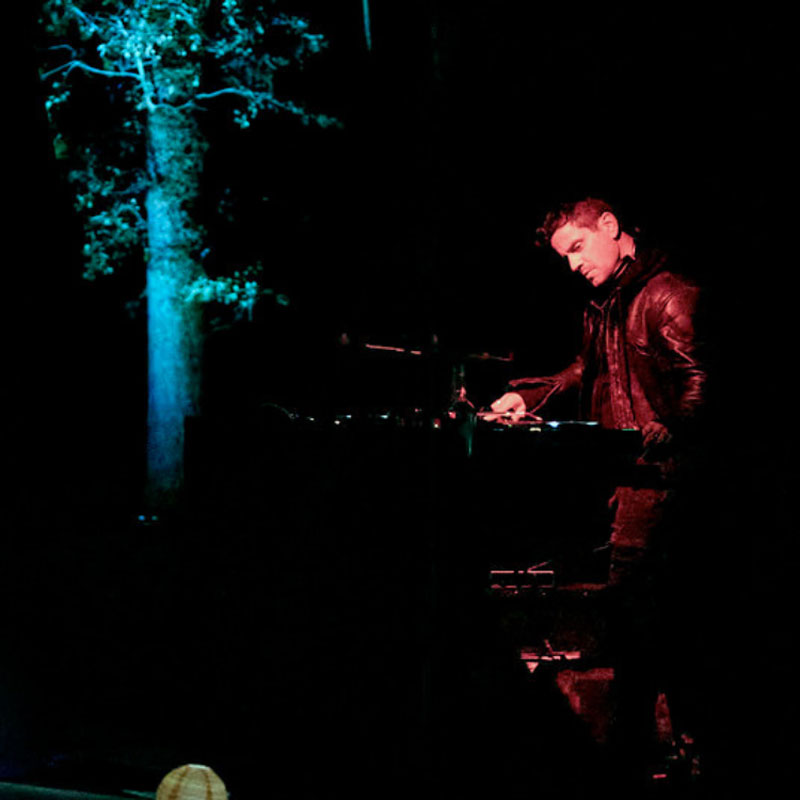
While Haack’s imprint remains audible in his work—in its sonic construction and experimental treatment, Dylan has crafted an entirely singular idiom, a signature style that speaks in no voice but his own. This voice clearest in his new record, Bittersweet Afternoon.
Nine tracks, each is its own a self-contained cosmos with distinct rules, mood, and emotional design. The album moves through cinematic passages, nostalgic echoes, and psychedelic surges that can draw susceptible minds into near-trance states. Bittersweet Afternoon behaves like a finely cut jewel, demanding observation from multiple perspectives, under changing lights, and from varied states of mind.
‘Ana Turn the Lights On‘ begins the set with a wistful, vintage‑tinged ballad. Fingerstyle guitar transports the ear—to a campfire under stars, or a secluded lodge, far from urban clamor, alone with a loved one. Dylan’s voice carries warmth and affection, yet the track holds a latent energy that invites motion, dance, a pulse in time. He strikes a careful balance, weaving just enough retro character to build a coherent world without slipping into pastiche or dusty nostalgia.
‘Flashbulb Memory‘ feat. Violeta Vicci adopts a wholly different tactic. Urban textures—distant traffic, scraps of dialogue—blend seamlessly with delicate Asian motifs that slowly rise to prominence. Here, the zither whispers, leaves rustle, a flute sighs, a bamboo fountain trickles and taps. Dylan guides a poetic transit, gently leading the listener from metropolitan buzz into a haven of calm. Deeply meditative.
‘In Absentia‘ captivates through hypnotic minimalism. The melody unfolds with a faint rhythmic breath; vocals drift, steady and sure. The effect is one of light hypnosis, a tranquil mesmerism. The tune holds attention through its quietude, its interior stillness. The voice acts as an accent—light, tactful, compelling enough to make one follow the track to its end, wondering what mystery lies beneath its serene surface.
‘The Shiver‘ extends the previous piece, forming a natural diptych. Melodic gentleness meets altered vocals that seem to speak from elsewhere, messages from a parallel realm. This construction suggests a gateway to another dimension, a private zone accessible only to a few. The track distinguishes itself by its fluidity, its trance‑like grip on the senses. A note to the sensitive: in heightened states, this song may induce profound absorption. Listen with care.
‘Fourteen Pilgrims over the Sava‘ concludes the album with a soft, mesmerizing composition that feels like a logical resolution to all that came before. From the opening notes comes a sensation of sinking underwater, descending into marine depths—yet without dread or suffocation. Instead, there is curiosity about this submerged world. Vocal phrases serve as a distant guide, occasionally drawing awareness back from a light trance, immersing the listener in an alternate reality where self and collective consciousness reflect one another.
The context of this album’s making deserves special mention. It was written and recorded during the COVID‑19 pandemic, an era many remember for its weight, uncertainty, and dread. Against that backdrop, ‘Bittersweet Afternoon‘ emits light, joy, and a resilient hope for brighter days. This paradox reveals creativity’s power to transmute despair into beauty. Returning to the record becomes a ritual—a temporary release from life’s burdens, from the press of urgent tasks. This is music for reflection, for inner conversation, for restoring balance. Highly recommended.
Discover more from Architects and Heroes
Subscribe to get the latest posts sent to your email.
